Store in a tightly closed container in a dry, cool, and well-ventilated place
Product Type
Industrial
Molecular Formula
C3H8O2
Ph Level
6.0 - 8.0 (100 g/l, H2O, 20 C)
Shape
Liquid
Application
Food, pharmaceutical, cosmetic, industrial, and chemical uses
Appearance
Clear, colourless liquid
CAS No
57-55-6
Purity
>99.5%
EINECS No
200-338-0
Molecular Weight
76.09 g/mol
Structural Formula
CH3-CHOH-CH2OH
Taste
Practically tasteless
Grade
Technical/USP Grade
Smell
Odourless
Poisonous
NO
Solubility
Miscible with water, alcohol, acetone, chloroform
Properties
Colourless, odourless, and tasteless. Hygroscopic and miscible with water, acetone, and chloroform.
Density
1.036 Gram per cubic centimeter(g/cm3)
Usage
Solvent, humectant, emulsifier, antifreeze, chemical intermediate
Ingredients
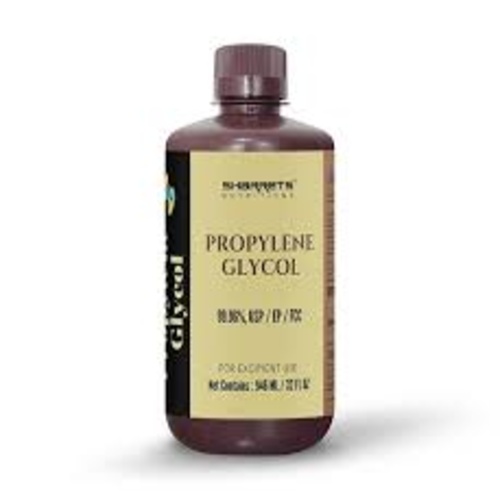
Propylene Glycol
Refractive Rate
1.431 - 1.433 (20 C)
Shelf Life
2 years
Melting Point
-59 C
HS Code
29053200
Auto Ignition Temperature
371 C
Surface Tension
36.1 mN/m at 20 C
Flash Point
99 C (Closed Cup)
Critical Temperature
351 C
Viscosity
58.1 mPas at 20 C
Boiling Point
187 C
Vapour Pressure
0.07 mmHg at 20 C
Packaging
230 kg drum, 25 kg drum, IBC tank or as required
Hazard Class
Non-Hazardous
Propylene glycol Trade Information
Minimum Order Quantity
1 Liter
Delivery Time
1 Week
About Propylene glycol
Propylene glycol (PG) is a versatile pharmaceutical excipient used primarily for its ability to dissolve a wide range of substances and maintain moisture. Classified as a diol or double alcohol (C3H8O2), it is a clear, odorless, and viscous liquid that is miscible with water.
Key Functions as an Excipient
Solvent & Co-solvent: Used in oral, topical, and parenteral (injectable) formulations to dissolve poorly water-soluble drugs. It is common in medications like diazepam, lorazepam, and phenytoin.
Humectant: Prevents formulations, particularly creams and ointments, from drying out by attracting and retaining moisture.
Preservative: In concentrations of 1530%, it can act as an antimicrobial agent to prevent spoilage.
Stabilizer: Helps maintain the physical stability of emulsions and prevents solid particles from settling in suspensions.
Viscosity Modifier: Adjusts the consistency and flow properties of liquid or semi-solid products.
Exceptional Purity and Versatile Applications
Propylene glycol stands out for its high purity (>99.5%) and adaptability across industries. Used in food, pharmaceuticals, cosmetics, and industrial sectors, it acts as a solvent, humectant, emulsifier, antifreeze, and chemical intermediate, highlighting its indispensable role in various formulations and processes.
Safe Handling and Storage Guidelines
As a non-hazardous and non-poisonous substance, propylene glycol offers safety in handling. However, it is essential to store it in tightly closed containers in a cool, dry, and well-ventilated area. Proper storage ensures the product maintains its quality and extends its shelf life up to two years.
FAQ's of Propylene glycol:
Q: How should propylene glycol be stored for maximum shelf life?
A: Propylene glycol should be stored in a tightly sealed container, in a dry, cool, and well-ventilated area. This ensures both quality preservation and safety, allowing the product's shelf life to extend to two years from the date of manufacture.
Q: What are the primary uses of propylene glycol in industry and consumer products?
A: Propylene glycol is used as a solvent, humectant, emulsifier, antifreeze, and chemical intermediate. It is widely found in food, pharmaceuticals, cosmetics, and industrial applications due to its safe, versatile, and stable properties.
Q: When is propylene glycol recommended for pharmaceutical or food applications?
A: Propylene glycol is ideal in pharmaceutical and food manufacturing where purity, non-toxicity, and compatibility are required. Its technical and USP grades make it suitable in formulations demanding stringent safety and efficacy standards.
Q: Where can I obtain propylene glycol and in what packaging options?
A: Propylene glycol is available through distributors, manufacturers, suppliers, and traders across India. Packaging options include 230 kg and 25 kg drums, IBC tanks, or customized as per customer requirements.
Q: What are the benefits of using propylene glycol over other solvents?
A: Propylene glycol is non-hazardous, odourless, tasteless, and exhibits excellent miscibility with water, acetone, and chloroform. Its stable profile, safety in various applications, and versatility make it a preferred choice in formulating products across multiple industries.
Tell us about your requirement
Price:
Quantity
Select Unit
50
100
200
250
500
1000+
Additional detail
Mobile number
Email
Name
Comapny Name
Phone Number
Email Id
City / State
Confirm Your Requirement
Verification Code
Did not receive yet?
Resend OTP
You’re Done!
We have received your requirements and will reply shortly with the best price.






 Send Inquiry

 Send Inquiry
 Send Inquiry
 Send SMS